Context
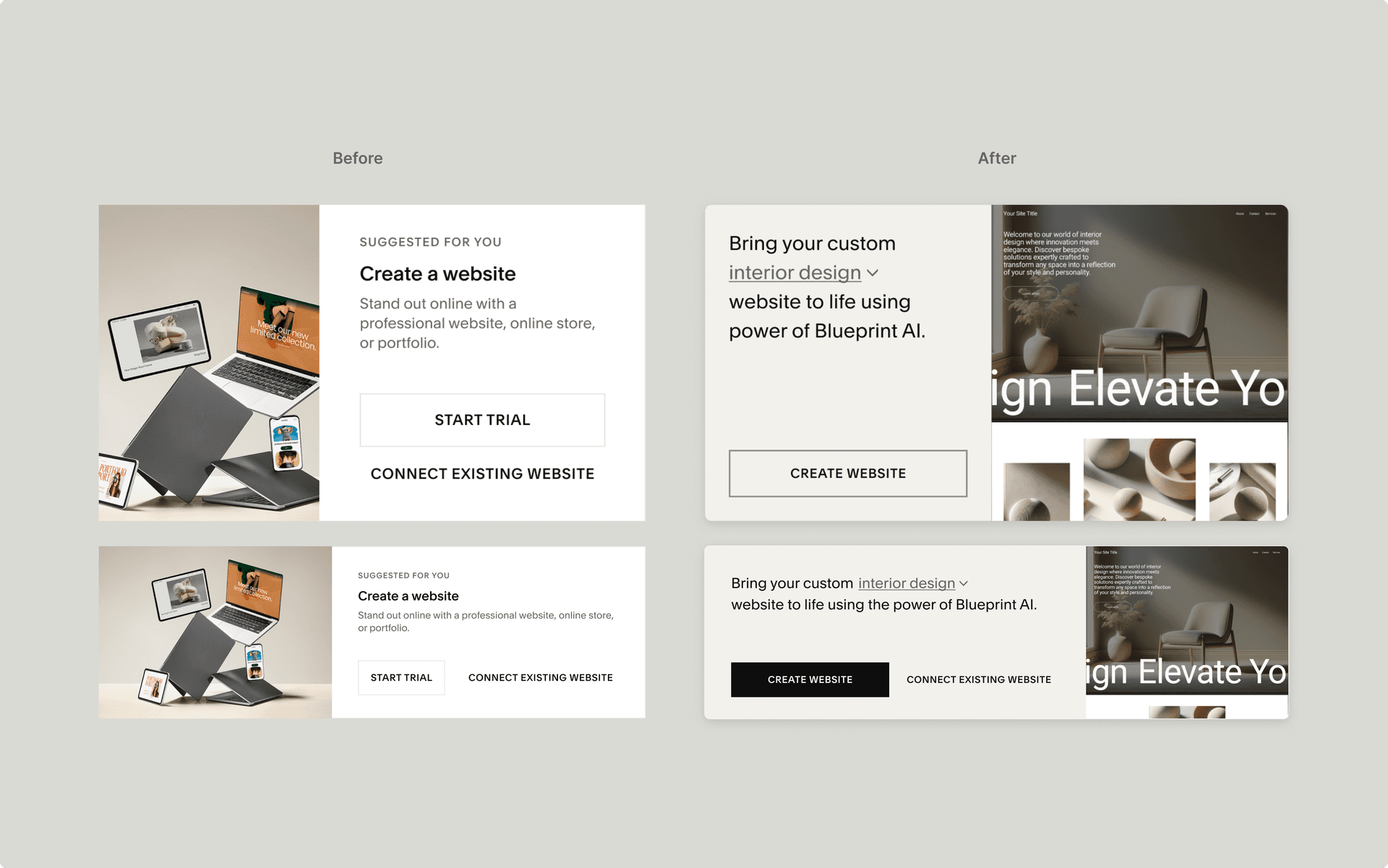
On Domains Overview, customers who just bought a domain saw the same generic "build a website" ad as everyone else. It was abstract, disconnected from what they actually had in front of them: a new domain, with a name that already said something about their business.
Domains Overview is a high-intent moment. Someone just paid for a domain. They're imagining a business, a portfolio, a project. The cross-sell needed to meet them in that imagining, not ask them to do the imagining themselves.
Problem
The static ad had a structural issue we couldn't fix with creative alone. It had to work for every domain we'd ever sold, which meant it couldn't speak to any specific one. Personalization required input from the user, and asking for input on a cross-sell ad defeats the purpose of the cross-sell.
DSML had been working on Gemini-based brand category predictions that could infer industry from a domain name alone. Early results showed about 60% accuracy across roughly 550 verticals. That number changed what was possible. Right often enough to lead with personalization, wrong often enough that we couldn't ignore the user's ability to correct us. That tension shaped the rest of the design.
Approach
The team worked through a confidence-tier model together, with engineering, PM, and design aligning on what each tier should produce. Above a confidence threshold, the customer sees a vertical-specific preview tailored to the predicted industry. Personal sites get their own dedicated treatment, since a meaningful chunk of domains are just people's names. Below threshold or with no prediction at all, the customer sees a generic but visually rich fallback. The tiers were a system decision, not a design decision, but the goal I owned was making sure the user never saw the seams. None of the tiers should feel like a fallback. None should expose the underlying ML logic.
The harder design problem was what to do when the prediction was wrong. The natural answer is a dropdown that lets the customer change their industry. But a dropdown on an ad is dangerous. It can read as "this is broken, please fix it for us," which is worse than no personalization at all.
What I pushed for was making the dropdown feel like continuation, not correction. The predicted industry sits in the selector by default, visible and editable. Changing it updates the preview immediately. And critically, when the customer clicks through to start building, that selection carries with them into Blueprint, our website creation flow. They land on Site Info with the right vertical pre-loaded. The dropdown isn't decoration on the ad. It's the seed of the workflow that hasn't started yet.

Solution
The result is a cross-sell that does three things the static ad couldn't. It shows a website that resembles the kind of business the customer's domain name points to, without asking them to fill anything out. It lets them adjust the industry if we got it wrong, without forcing the correction. And it passes both signals, the AI prediction and the user's selection, forward into the website creation flow, so they're inputs to the rest of the experience rather than one-time choices made on an ad.
Impact
The personalized preview improved 7-day view-to-click rate on the website cross-sell by 13% over the static control. Downstream conversion improved too: roughly 15% higher 14-day view-to-website-subscription rate for customers who saw the personalized preview. We treated the personalized variant as the new control in October 2025, and DSML backfilled brand categories for around 9 million existing domains so the experience could expand beyond newly registered ones.
The bigger outcome is the pattern: confidence tiers, plus a user override, plus a preview that carries forward into creation. It's a reusable way to personalize a cross-sell from signals Squarespace already has, without asking the customer for anything up front. It has since been reused on the Website panel and the Domain list, and informed the next investment: an explicit data collection survey that strengthens the prediction layer underneath.